
Displaying Consumer Information in Your Catalog
June 2, 2026
Federal law requires higher ed institutions to publicly disclose a wide range of information, including financial aid policies, graduation rates, campus safety data, FERPA policies, and accreditation details. While most schools already know this, the difficult part is keeping it all organized, accessible, and easy for students to find.
For many institutions, this information is scattered across PDFs managed by different departments, linked from various corners of the website, and updated inconsistently. Broken links, duplicate content, and accessibility gaps are unfortunately common occurrences. Given that consumer information pages are typically updated once a year, version control can quickly become a headache for your staff.
A Single Hub for Required Disclosures
With Clean Catalog, institutions can build a centralized consumer information page directly within their catalog platform. Rather than sending students through a maze of departmental websites and downloadable PDFs, everything can instead live in one searchable, web-based location within the same branded experience as the rest of your catalog.
This makes it easier for students to find what they need, and easier for your team to maintain. When disclosures need to be updated, you're working in one place instead of tracking down content across a dozen different pages.
WVJC Charleston: A Real Example
We recently worked with WVJC Charleston to build out a dedicated consumer information section within their catalog. The final product is a landing page that organizes institutional disclosures, including policies, reporting information, and required resources, all in a way that's straightforward for students to use.
The consumer information tab is easily accessed from the homepage of their catalog, with content organized within an expandable table of contents. While we customized this design for WVJC, each institution can tailor the layout and structure to fit its own accreditation requirements and internal workflows.
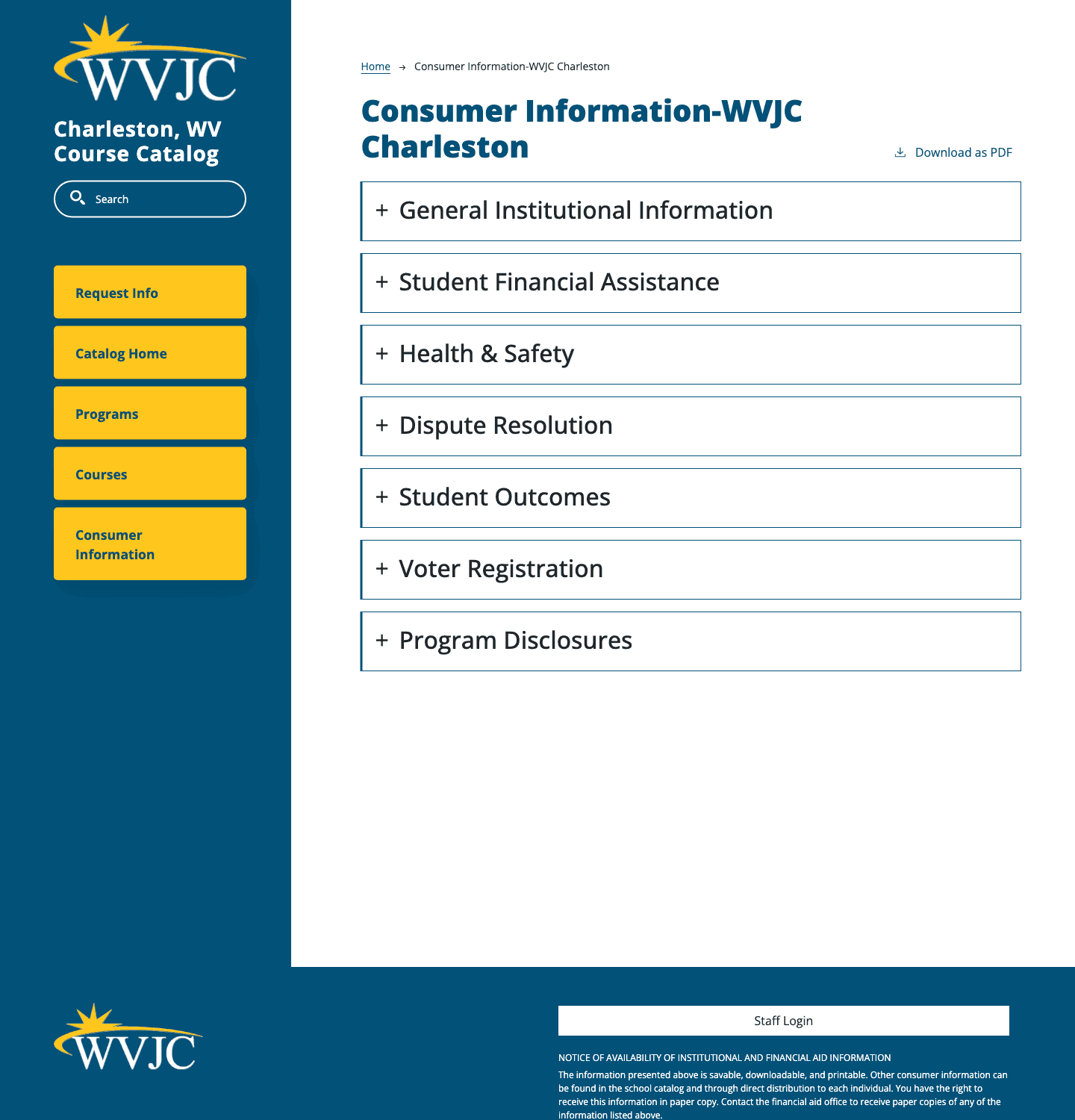 WVJC Charleston's consumer information page organizes required disclosures into a branded, web-based table of contents that is easier for students to browse and easier for staff to maintain.
The Bottom Line
A centralized consumer information page isn't just a compliance checkbox. It's a better experience for students and less ongoing admin work for your staff. If you're still managing disclosures through scattered PDFs and departmental web pages, it's worth considering a more sustainable, accessible approach.
To learn more or see additional examples, contact our team or browse our catalog showcase.